In the hushed stillness before dawn, when the stars still cling to the velvet sky of the high Andes, a priest of Inti would begin his ascent. Each step up the sheer, polished stone of the Coricancha in Cusco was a ritual in itself, a movement closer to the divine. Far across the world, in the Valley of Mexico, another figure, a shaman-priest of a civilization whose name is lost to us, would stand atop the Pyramid of the Sun in Teotihuacan. He too awaited the first golden sliver of light, a moment of cosmic realignment. Separated by millennia, geography, and culture, these two souls were participants in a silent, profound dialogue—a conversation between civilizations that never met, yet spoke the same elemental language of sun, stone, and cosmos. This is the story of that pre-Spanish era dialogue between Teotihuacan and the Sun Temple of Cusco.
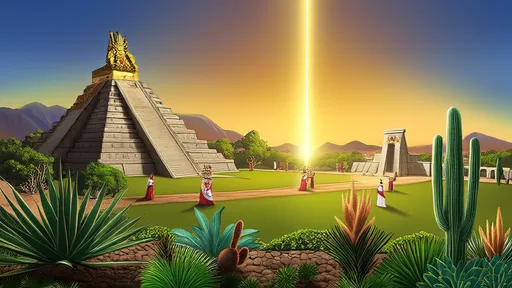
The very essence of this dialogue begins with their relationship to the sun. For both cultures, the sun was not merely a celestial body; it was the central actor in the drama of existence, the source of life, time, and imperial authority. In Teotihuacan, a city that reached its zenith between 100 and 550 CE, the sun was venerated through its most monumental expression: the Pyramid of the Sun. This colossal structure, one of the largest ever built in the ancient Americas, was not just a temple to the sun but was conceived as a terrestrial manifestation of the sun. Its alignment, carefully calibrated to astronomical events, suggests it was a place where the earthly and celestial realms converged. The pyramid’s orientation captures the sun's passage on key dates, perhaps the zenith passages or equinoxes, turning the entire city into a colossal solar calendar. Power here was cosmic; to control the pyramid was to mediate between humanity and the life-giving star.
A thousand years later and four thousand kilometers to the south, the Incas engineered a similar concept with breathtaking precision at the Coricancha, the "Golden Enclosure," in Cusco. If Teotihuacan’s approach was one of monumental scale, the Incan approach was one of exquisite refinement and symbolic density. The Coricancha was the spiritual and geographical heart of the Inca Empire, Tawantinsuyu. Its walls, famously sheathed in gold to mimic the sun's brilliance, housed not only the Temple of Inti but also sanctuaries to other celestial bodies, establishing a hierarchy with the sun as the sovereign. The Incas understood their emperor, the Sapa Inca, to be the direct descendant of Inti, the Sun God. Thus, the Coricancha was more than a temple; it was the symbolic residence of the divine ancestor of the ruling dynasty, the anchor of a state ideology that justified expansion and control. The sun’s journey across the sky mirrored the empire's reach.
This dialogue extends into the very stone from which these sacred centers were built. The architecture of both Teotihuacan and the Coricancha reveals a deep, sophisticated understanding of sacred geography and geomancy—the art of aligning structures with the powerful energies of the landscape. Teotihuacan is a masterpiece of urban planning on a cosmic scale. The Avenue of the Dead, flanked by immense platforms and pyramids, runs with a slight deviation from true north, an alignment that scholars argue was intentionally designed to mirror the Milky Way or specific sacred mountains on the horizon. The Pyramid of the Sun itself was built over a natural cave, which was considered a portal to the underworld, the realm of creation and ancestors. By building the sun’s pyramid upon this cave, the Teotihuacanos physically and symbolically connected the three realms: the underworld, the earthly plane, and the heavens.
The Incas, masters of what is often called "sacred architecture," performed a similar act of geographical consecration in Cusco. The entire city was laid out in the shape of a puma, a sacred animal, with the Coricancha forming its tail. More profoundly, the Incas engineered a system of ceques, invisible lines radiating from the Coricancha across the valley. These ceques were both hydrological and spiritual alignments, connecting hundreds of huacas (sacred shrines)—springs, stones, mountains—in a vast cosmological web. The Coricancha was the nodal point, the axis mundi of this system. The temple's flawless, mortarless stonework, with stones fitted so tightly a razor blade cannot slip between them, was not merely a display of engineering prowess; it was a form of reverence. The stones were alive, and by fitting them with such precision, the builders were creating a harmonious, earthquake-resistant structure that was in active, respectful dialogue with the living earth.
Where the dialogue becomes most intricate is in the realm of cosmology and ritual practice. Both civilizations operated within a cyclical view of time, where ritual was essential to maintaining the cosmic order and preventing cosmic collapse. At Teotihuacan, this is evident in the sacrificial offerings found within the pyramids—not just of precious objects, but of humans and animals. These acts were likely perceived as necessary sacrifices to nourish the gods and ensure the sun's continued journey across the sky. The murals of Teotihuacan, though faded, depict a pantheon of gods related to water, fertility, and storm, often intertwined with celestial symbols. Ritual was a public, state-sponsored spectacle designed to reinforce the social order and the city's role as the center of the universe.
The Incas, while sharing the concept of sacrificial offering (including the capacocha, the sacrifice of unblemished children on high mountain peaks), integrated solar worship into the very fabric of daily life and state administration. The Inti Raymi, the Festival of the Sun, was the most important event in the imperial calendar. During the winter solstice, as the sun reached its furthest point from Cusco, the Sapa Inca would lead elaborate ceremonies at the Coricancha and the main plaza, pleading with Inti to return. It was a moment of high drama and state theatre, solidifying the Inca's role as the primary intermediary. Furthermore, the sun dictated the agricultural cycle, and by extension, the labor tax system of the empire. Worship was not separate from governance; it was governance.
Ultimately, the most poignant aspect of this trans-temporal dialogue is the legacy of mystery and influence. Teotihuacan's influence was vast, radiating across Mesoamerica for centuries after its mysterious decline around 550 CE. Its architectural style, religious symbols, and perhaps even its core ideology were adopted and adapted by later cultures, including the Aztecs, who gave the city its current name, meaning "The City of the Gods." Yet, the voices of its people are silent; we know them only through their archaeology.
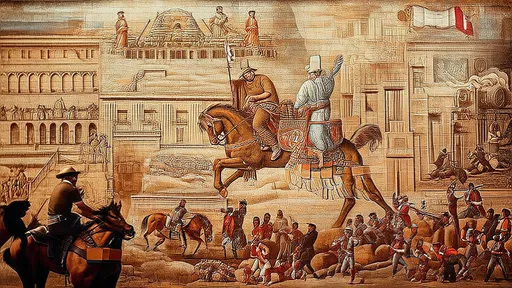
The Inca, in contrast, had their history partially recorded by the Spanish conquistadors and chroniclers, albeit through a distorted lens. The Coricancha was tragically dismantled, its gold looted, and the Santo Domingo church built upon its foundations. Today, the visitor sees a jarring but powerful palimpsest: the graceful curves of a Spanish Baroque convent rising from the unmovable, precise stonework of the Inca temple. It is a physical manifestation of the collision of two worlds, a stark reminder of the dialogue that was violently interrupted.
The conversation between the Pyramid of the Sun and the Coricancha is one held in the vocabulary of absolute power, divine kingship, and celestial order. It is a dialogue that speaks of humanity's enduring attempt to build heavens on earth, to anchor fleeting empires to the eternal cycles of the cosmos. Though their priests never met, though their armies never clashed or traded, they were united by a shared, monumental ambition: to capture the essence of the sun in stone and in ceremony, and in doing so, to become, themselves, indispensable to the universe's continued turning. In the silent, enduring presence of their ruins, that ambition, and that dialogue, echo still.
By /Sep 28, 2025
By /Sep 28, 2025

By /Sep 28, 2025
By /Sep 28, 2025
By /Sep 28, 2025

By /Sep 28, 2025
By /Sep 28, 2025

By /Sep 28, 2025
By /Sep 28, 2025

By /Sep 28, 2025
By /Sep 28, 2025
By /Sep 28, 2025
By /Sep 28, 2025
By /Sep 28, 2025

By /Sep 28, 2025
By /Sep 28, 2025
By /Sep 28, 2025

By /Sep 28, 2025
By /Sep 28, 2025
By /Sep 28, 2025
