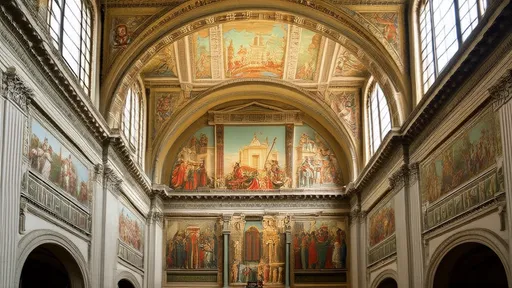
Walking through the grand courtyard of Mexico's National Palace, one is immediately enveloped by a monumental narrative that stretches across the walls. This is the work of Diego Rivera, a titan of Mexican art, whose murals within this seat of power are not mere decorations but a profound, sprawling epic of a nation's soul. Commissioned in the aftermath of the Mexican Revolution, Rivera's project was ambitious: to chart the course of Mexican history from its ancient indigenous origins to a hopeful, if contested, modern future. The murals are a visual symphony of color, movement, and ideology, a place where the past speaks directly to the present.
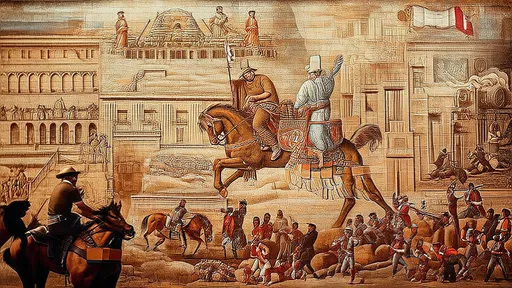
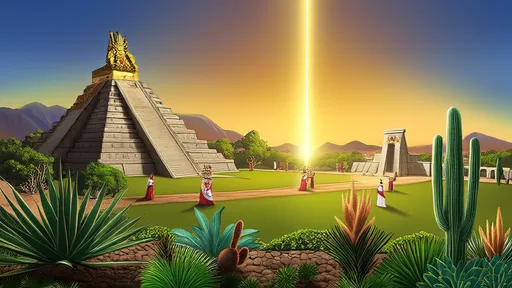
The journey begins on the main staircase, where the sheer scale of Rivera's vision becomes breathtakingly clear. The central wall is dominated by a panoramic depiction of pre-Columbian Mexico. Here, Rivera presents a vision of a sophisticated, organized, and harmonious society. We see the bustling markets of Tenochtitlan, teeming with life and commerce, where artisans, farmers, and traders engage in a vibrant economy. The depiction of the Aztec world is not one of savage barbarism, as often portrayed by colonial narratives, but one of complex social structures, advanced agricultural techniques, and rich cultural traditions. Figures are rendered with a monumental solidity, their forms echoing the sculptures of ancient temples, grounding Mexico's identity in a glorious and autonomous past.
This idyllic vision is brutally interrupted by the arrival of the Spanish conquistadors. Rivera masterfully uses composition and symbolism to convey the violence and cultural cataclysm of the Conquest. The Spanish figures, often armored and mounted on powerful horses, are depicted with a harsh, almost grotesque realism, their faces marked by greed and fanaticism. They stand in stark contrast to the more naturalistic and integrated forms of the indigenous people. Scenes of battle, forced labor, and the destruction of temples are juxtaposed with the figure of Hernán Cortés, portrayed not as a heroic explorer but as a haunted, isolated figure. The narrative is unflinching, highlighting the exploitation, disease, and religious imposition that decimated native populations and forged a new, painful social hierarchy based on race and bloodline.
As the mural cycles continue along the corridors of the second floor, Rivera turns his focus to the long and turbulent struggle for independence and the subsequent political upheavals of the 19th century. He populates these scenes with a cast of historical figures—Miguel Hidalgo, José María Morelos, Benito Juárez—each rendered with careful attention to their role in the nation's development. However, Rivera's history is not a simple chronicle of "great men." True to his Marxist convictions, he emphasizes the role of the masses. Peasants, workers, and soldiers are the true engines of history, their collective struggles pushing the nation forward against the interests of the conservative elite, the Catholic Church, and foreign capital, often represented by caricatured figures of bankers and industrialists.
The heart of Rivera's critique, and the most politically charged section of the murals, is his portrayal of the Mexican Revolution and its aftermath. This is not a sanitized, official history but a chaotic, bloody, and deeply personal reckoning. Pancho Villa's cavalry charges across the walls, Emiliano Zapata stands firm with his demand for Tierra y Libertad (Land and Liberty), and anonymous soldiers fight and die in landscapes scarred by conflict. Rivera does not shy away from depicting the internal divisions and betrayals that plagued the revolutionary forces. The promised land reform and social justice remain incomplete, hinted at in scenes where campesinos still confront the power of wealthy landowners. This section serves as a powerful reminder of the unfinished business of the revolution, a direct challenge to the political establishment operating within the very building the murals adorn.
Perhaps the most fascinating and controversial aspect of the National Palace murals is Rivera's projection of Mexico's future. In the north wall of the main staircase, he presents a utopian, industrial vision. Here, artists, scientists, and workers collaborate in a technologically advanced society freed from the shackles of capitalism and imperialism. Karl Marx himself is depicted, pointing the way forward from the center of the composition. This section has been widely interpreted as a reflection of Rivera's complex relationship with the Soviet Union and his idealistic faith in a socialist future. For the Mexican government housing this work, it presented a paradox: celebrating an artist whose ultimate vision critiqued the very system the palace represented.
To fully appreciate these murals is to understand that they are a palimpsest of meaning, layered with symbolism, allegory, and Rivera's own political passions. He seamlessly blends pre-Columbian motifs with European artistic traditions, creating a uniquely Mexican visual language. Every element, from the tools in a worker's hand to the specific plants native to Mexico, is charged with significance. The murals are a didactic tool, intended to educate a largely illiterate population about their history and their rights. They were art for the public, by the public, in the most public of spaces.
Today, decades after their completion, the murals of the National Palace remain as vital and provocative as ever. They continue to spark debate about national identity, historical memory, and social justice. They challenge viewers to consider whose history is told and from what perspective. Diego Rivera did not just paint the history of Mexico; he actively participated in shaping it, using his brush as a weapon to advocate for a more equitable society. To stand before these walls is to engage in a dialogue with the past, a conversation about power, resistance, and the enduring hope for a better tomorrow, all masterfully orchestrated by one of the twentieth century's most compelling artistic voices.
By /Sep 28, 2025
By /Sep 28, 2025

By /Sep 28, 2025
By /Sep 28, 2025
By /Sep 28, 2025

By /Sep 28, 2025
By /Sep 28, 2025

By /Sep 28, 2025
By /Sep 28, 2025

By /Sep 28, 2025
By /Sep 28, 2025
By /Sep 28, 2025

By /Sep 28, 2025
By /Sep 28, 2025

By /Sep 28, 2025

By /Sep 28, 2025

By /Sep 28, 2025

By /Sep 28, 2025

By /Sep 28, 2025

By /Sep 28, 2025
