From the misty coastal markets of Lima to the sizzling street stalls of Mexico City, the Americas offer a culinary journey like no other. The continent's food scene is a vibrant tapestry woven from indigenous traditions, colonial influences, and modern innovation. To truly understand the soul of the Americas, one must venture beyond the white-tablecloth restaurants and into the bustling, aromatic heart of its public markets and humble street-side cocinas. This is where flavors are most honest, where recipes passed down through generations are served with a side of local life, and where every bite tells a story of geography, history, and community.
Our exploration begins in Lima, Peru, a city now globally recognized as a gastronomic powerhouse. The journey, however, doesn't start in a trendy Miraflores eatery, but in the chaotic, sensory-overloading Mercado Central. Here, the air is thick with the salty scent of the Pacific Ocean, just a few miles away. Stalls overflow with impossibly fresh seafood: glistening piles of ceviche-ready corvina, fat scallops, and exotic specimens like the giant *conchitas*. The true initiation is at one of the market's simple cevicherías. A plate of ceviche here is a revelation—chunks of pristine fish "cooked" not by heat, but by the acidic punch of freshly squeezed lime juice, known as *leche de tigre* or "tiger's milk." It's spiked with slivers of fiery *ají limo* chili and served with slices of sweet potato and crunchy *cancha* (toasted corn). This is Peru on a plate: bright, bold, and unapologetically fresh.
But Lima's market scene doesn't end with the ocean's bounty. A short distance away, the Mercado de Surquillo offers a more intimate, though no less vibrant, experience. This is where local chefs shop, a testament to its quality. The colors are dizzying: pyramids of multicolored potatoes from the Andes, over fifty varieties of native corn in shades of purple, black, and yellow, and baskets overflowing with Amazonian fruits like *camu camu* and *aguaymanto*. Here, one can sample fruits unknown to the outside world and understand the incredible biodiversity that forms the foundation of Peruvian cuisine. It’s a living laboratory of ingredients that have sustained cultures for millennia.
From the Pacific coast, our culinary map heads north, traversing the Andes to the high plains of Bolivia. In the bustling witches' market of La Paz, the offerings are as much about tradition as they are about taste. Yet, for a true street food experience, one must try salteñas. These are not mere empanadas; they are a delicate art form. A perfectly made salteña has a slightly sweet, glossy dough that encapsulates a juicy, savory stew of meat, potatoes, peas, and olives, thickened with a gelatin that melts upon baking. The trick is to eat it without spilling a drop of the precious, fragrant broth—a skill locals perform with effortless grace. Washed down with a glass of *api*, a warm, purple corn drink, it’s the ultimate Bolivian comfort food, a hearty defense against the crisp mountain air.
Crossing into Brazil, the energy shifts. In São Paulo's Municipal Market, Mercadão, the scale is monumental. Under a vast stained-glass dome, vendors hawk everything from dried meats to exotic Amazonian fish. The must-try here is the legendary mortadella sandwich at Bar do Mané. A mountain of thinly sliced mortadella is piled onto a simple Portuguese roll, often with a slice of melting cheese, creating a monument of savory indulgence. It’s messy, overwhelming, and utterly delicious—a perfect reflection of São Paulo's own larger-than-life personality. Meanwhile, on the streets of Rio de Janeiro, the smell of pão de queijo (cheese bread) wafts from every corner bakery. These small, gluten-free cheese puffs, made with tapioca flour, are addictive. Crispy on the outside, chewy on the inside, they are a simple pleasure that encapsulates the warmth of Brazilian hospitality.
The journey continues northward, through the Caribbean influences of Colombia and Venezuela, where arepas—grilled corn cakes stuffed with endless fillings—reign supreme. But our destination lies further north, in the vibrant, chaotic, and endlessly creative food scene of Mexico City. If Lima's markets are about pristine ingredients, Mexico City's are a masterclass in transformation. The Mercado de Jamaica, the city's famed flower market, is a riot of color and scent, but its food stalls are equally compelling. However, the true soul of the city's cuisine is found on the streets.
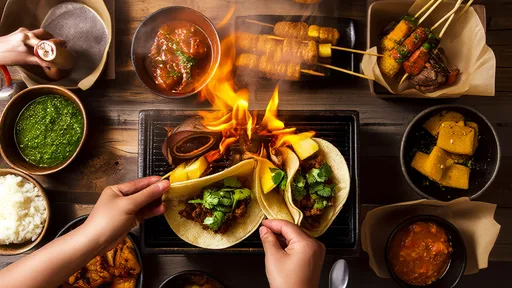
As evening falls, the city transforms. Makeshift stalls appear as if by magic, their grills lighting up the night. The sound of sizzling fat and the smell of roasting corn are the city's soundtrack and perfume. This is the kingdom of the taco, a deceptively simple food that achieves sublime heights. One must venture to a busy intersection in a neighborhood like Condesa or Roma, or better yet, delve into the historic center, to find a master at work. The choices are staggering: tacos al pastor, a gift from Lebanese immigrants, featuring spit-grilled pork marinated in chilies and achiote, shaved directly onto a corn tortilla and topped with pineapple. The first bite is a perfect harmony of sweet, savory, and spicy.
Then there are the carnitas stalls, dedicated entirely to the art of confiting pork in its own fat until it is unbelievably tender and crisp. The vendor asks which part you prefer—the lean *maciza*, the rich *buche* (stomach), or the crispy *cuerito* (skin)—and chops it to order with a heavy cleaver. Served with a sprinkle of salt, a handful of fresh cilantro, and a fiery salsa verde, it’s a taco of profound depth and simplicity. For the adventurous, there are tacos de cabeza, utilizing every part of the cow's head, each offering a different texture and flavor, from the creamy *sesos* (brains) to the gelatinous *cachete* (cheek).
But Mexico City's street food empire extends far beyond tacos. Early mornings are for tamales, steamed masa dough filled with chicken or pork in a rich mole or salsa verde, all wrapped in a corn husk. They are the fuel for the city's start. For a late-night snack, nothing beats elotes and esquites—corn on the cob or kernels in a cup, slathered with mayonnaise, cotija cheese, chili powder, and lime. It’s a messy, tangy, creamy, and spicy combination that is inexplicably perfect.
This gastronomic map, from Lima to Mexico City, charts more than just a change in latitude. It traces a story of adaptation and resilience. It shows how ancient grains like corn form a common thread, morphing into tortillas, arepas, and tamales. It reveals how European ingredients were absorbed and reinvented, creating entirely new creole cuisines. Most importantly, it demonstrates that the most vital and exciting food cultures are often those that are lived publicly, served on a paper plate, and enjoyed standing on a street corner. To eat your way through the markets and stalls of the Americas is to engage in a continuous, delicious conversation with its people, its history, and its land. The journey is endless, and every corner holds a new flavor waiting to be discovered.
By /Sep 28, 2025

By /Sep 28, 2025

By /Sep 28, 2025

By /Sep 28, 2025
By /Sep 28, 2025

By /Sep 28, 2025

By /Sep 28, 2025

By /Sep 28, 2025
By /Sep 28, 2025

By /Sep 28, 2025
By /Sep 28, 2025
By /Sep 28, 2025
By /Sep 28, 2025
By /Sep 28, 2025

By /Sep 28, 2025
By /Sep 28, 2025

By /Sep 28, 2025

By /Sep 28, 2025

By /Sep 28, 2025

By /Sep 28, 2025
