German Expressionism meets Chinese ink wash in a vibrant dialogue of colors and philosophies at the ongoing exhibition "Resonance: Contemporary Art from China and Germany". At the heart of this cross-cultural conversation is artist Li Lei, whose large-scale abstract paintings serve as a bridge between two distinct artistic traditions, proving that profound connection often arises from apparent contrast.
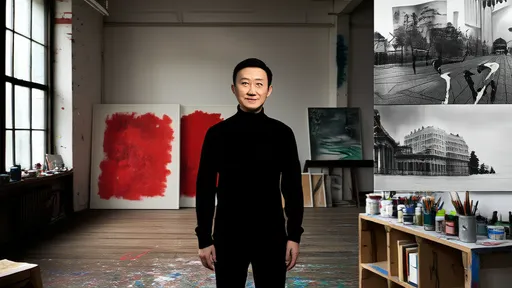
Walking through the exhibition hall, one is immediately struck by the sheer energy emanating from Li Lei's canvases. They are not quiet, contemplative pieces but explosive fields of color that seem to capture a moment of cosmic creation. Yet, amidst the dynamic splashes of acrylic, there is a distinct sense of order and spiritual depth, a characteristic he attributes to the subtle influence of his Chinese heritage. "My foundation is in Chinese philosophy, particularly the Daoist concept of 'Qi' or vital energy," Li explains during a quiet moment at his studio. "The brushstroke, whether with ink or acrylic, is a channel for this energy. It's about capturing the movement of life itself."
This pursuit of capturing the intangible resonates deeply with the legacy of German Expressionism, a movement that sought not to replicate the external world but to express inner emotional realities. Artists like Wassily Kandinsky and Franz Marc explored spirituality through abstraction, breaking away from representational forms to communicate directly with the soul of the viewer. It is this shared ambition—to make the invisible visible—that forms the first powerful chord of resonance between Li Lei's work and the German artistic spirit. "When I first encountered German Expressionist works, I felt an immediate kinship," Li recalls. "They were not painting a tree; they were painting the feeling of the tree, its essence. This is very close to the Chinese idea of capturing the 'spirit' or 'Shen' of a subject."
The collision, however, is as significant as the共鸣. Li Lei's artistic language, while spiritually aligned, is distinctly his own. Where traditional Chinese ink painting often values restraint, subtlety, and vast areas of empty space (liubai), Li's work is unapologetically bold and saturated. He employs a rich, almost symphonic palette, layering colors with a physicality that echoes the gestural intensity of artists like Ernst Ludwig Kirchner. This is not a simple fusion but a creative friction. "I am not trying to create a 'East meets West' hybrid," he asserts. "That is too simplistic. It is more about allowing these two powerful currents to collide within me. The tension is where the new energy is born."
This process of "collision and harvest" is vividly displayed in his series "Floating Worlds." The paintings are turbulent yet harmonious, with forms that suggest both microscopic cellular structures and vast, nebulous galaxies. One can detect the fluid, spontaneous quality of ink wash techniques, but the medium is defiantly modern—acrylic, often applied with palette knives, squeegees, and even his hands. The result is a surface that is thick, textured, and pulsating with life. It is a visual metaphor for his artistic journey: rooted in the flowing spirit of Daoism but expressed with the vigorous, confrontational language of Western abstraction.
For Li Lei, the dialogue extends beyond the canvas and into the very method of creation. He describes his studio practice as a form of performance, a dance between control and surrender. "I begin with an intention, a feeling, but I must also be open to accident," he says. "The paint has its own will. Like in Chinese philosophy, there is a balance between the active (Yang) and the receptive (Yin). I am the Yang, initiating the action, but I must also be Yin, receptive to what the materials and the moment offer." This approach mirrors the German Expressionists' embrace of raw, unfiltered emotion and spontaneous mark-making, yet it is framed within a distinctly Eastern framework of balance.
The resonance is also deeply intellectual. Li Lei speaks passionately about the writings of German philosophers, particularly those who grappled with the relationship between art, spirit, and existence. The works of Friedrich Nietzsche, with his ideas about the Dionysian creative force, and Martin Heidegger's explorations of "Being," have provided a philosophical underpinning for his artistic explorations. "They offer a language, a structure, to understand the chaotic beauty I try to capture," he notes. "It's fascinating to see how thinkers from such different cultures arrive at similar questions about human existence and the role of art. This philosophical common ground makes the artistic exchange much richer and more profound."
Curators and critics have noted that Li Lei's work does not merely illustrate this cultural exchange; it embodies it. Dr. Helena Schmidt, a co-curator of the exhibition, observes, "Li Lei's art is a testament to the fact that in our globalized world, influence is not a one-way street. He is not a Chinese artist borrowing Western styles. He is a contemporary artist who has digested multiple traditions and synthesized them into a unique visual language that speaks to universal human concerns—wonder, chaos, tranquility, and the search for meaning."
The success of this exhibition and the compelling narrative of Li Lei's work suggest a promising future for transnational artistic dialogue. In an era often marked by division, art remains a potent force for connection. The resonance between Chinese and German art, as demonstrated by Li Lei, is not about erasing differences but about finding a shared frequency of human experience. It proves that when different cultural spheres collide with respect and creative courage, the result is not noise, but a more complex and beautiful harmony.
For Li Lei, the journey of collision and inspiration is ongoing. "Every new painting is a new conversation," he says, gazing at a work-in-progress in his studio. "The dialogue between my heritage and the world I engage with today never stops. It is challenging, sometimes confusing, but always incredibly inspiring. That is where the true resonance lies—in the perpetual, fruitful tension of becoming." His work stands as a bold invitation to viewers to listen closely, to perceive the deep harmonies that can emerge from the meeting of different worlds, and to find their own inspiration in the beautiful collisions of life.
By /Sep 26, 2025
By /Sep 26, 2025
By /Sep 25, 2025
By /Sep 25, 2025
By /Sep 26, 2025
By /Sep 26, 2025
By /Sep 25, 2025
By /Sep 26, 2025
By /Sep 26, 2025
By /Sep 25, 2025
By /Sep 25, 2025
By /Sep 25, 2025
By /Sep 26, 2025
By /Sep 26, 2025
By /Sep 25, 2025
By /Sep 26, 2025
By /Sep 25, 2025
By /Sep 25, 2025
By /Sep 26, 2025
By /Sep 25, 2025
