Under the velvet dome of a Hangzhou night, where the Qiantang River whispers ancient tales, a new celestial dialogue begins. The exhibition "Starry Sky: Our Shared Horizon" has transformed the city's contemporary art museum into a portal between cosmic wonder and terrestrial unity, weaving astronomy with anthropology in a breathtaking tapestry that speaks to the very essence of human connection.
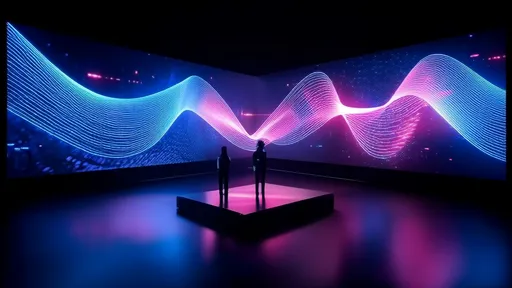
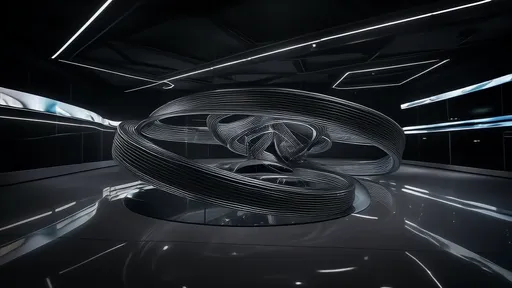
The moment visitors cross the threshold, they are greeted not by a traditional gallery space, but by an immersive installation titled "Cosmic Dust". The room is plunged into darkness, punctuated by countless points of light that drift slowly across walls, floor, and ceiling. This is no ordinary star map; it is a living, breathing representation of our local galactic neighborhood. As one's eyes adjust, the subtle hum of a cello, tuned to the resonant frequencies of pulsars, fills the air. The artist, Li Wei, a former astrophysicist, explains that the installation is designed to evoke a profound sense of scale and shared origin. "We are all made of stardust," he murmurs to a captivated group. "The iron in our blood, the calcium in our bones—every element heavier than hydrogen was forged in the heart of a long-dead star. This exhibition is about remembering that fundamental kinship."
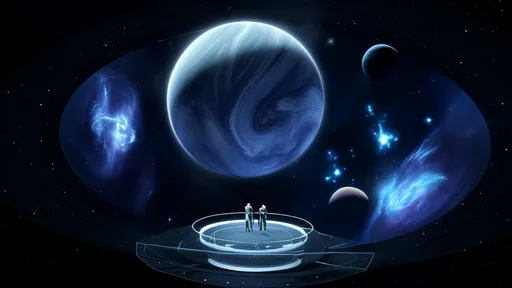
This theme of kinship resonates through the subsequent hall, "Echoes from the Pale Blue Dot". Here, the focus shifts from the macrocosm to the microcosm of human experience. A circular chamber displays a 360-degree panoramic video projection, seamlessly blending time-lapses of star trails over iconic landscapes across all seven continents. The aurora borealis dances above Iceland's glaciers as the Milky Way arcs over the dunes of the Sahara; the Southern Cross hangs above a quiet Maori village in New Zealand while city lights twinkle beneath the same sky in Shanghai. The curation is deliberate and powerful. There are no borders drawn on these landscapes, no flags, no demarcations. The only constant is the celestial vault above, a universal canopy shared by every human, animal, and plant on the planet. The accompanying audio is a collage of human sounds—laughter from a market in Nairobi, a lullaby sung in Quechua, the solemn chant of Tibetan monks—all blending into a harmonious, if complex, symphony of life on Earth.
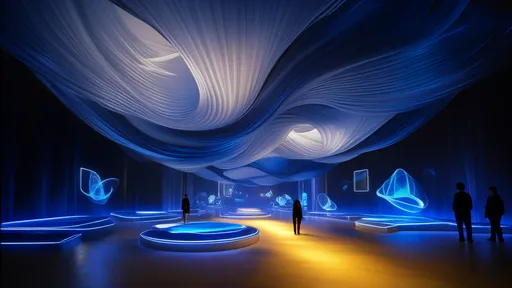
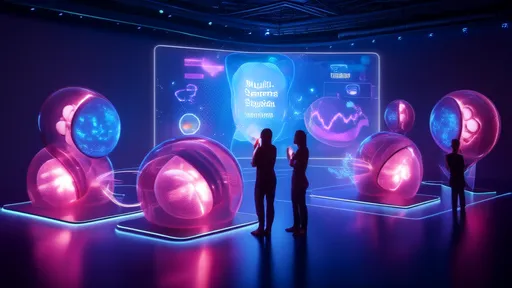
The exhibition's centerpiece, and perhaps its most poignant statement, is the interactive sculpture "The Gravity of Connection". Suspended from the high ceiling is a large, luminous sphere representing Earth. From it, thousands of slender, fiber-optic threads extend downward, each terminating at a small, handheld interface. Visitors are invited to take hold of a thread. As they do, their pulse is detected by a sensor. A soft light travels up the thread they hold, and their heartbeat is translated into a unique, gentle vibration that courses through the entire sculpture. The sphere subtly brightens and dims in response to the collective rhythm of all present. It is a tangible, real-time metaphor for interdependence. A child's rapid, excited pulse contributes as much to the whole as the steady, calm rhythm of an elder. The message is inescapable: every individual's existence subtly influences the collective state of our world.
Moving deeper, the exhibition confronts the challenges of the modern era head-on. A section titled "Silent Sky" addresses the growing threat of light pollution. Visitors walk through a tunnel where the starry sky above gradually fades, drowned out by the simulated orange glow of urban sprawl. Statistics are projected onto the walls, not as dry numbers, but as haunting narratives: "In many major cities, an entire generation has grown up without ever seeing the Milky Way." This loss is framed not just as an astronomical tragedy, but as a cultural and spiritual one, severing a connection that has inspired art, philosophy, and science for millennia. The section powerfully argues that preserving dark skies is an act of preserving a common human heritage.
The final gallery, "Messages for the Future", offers a proactive and hopeful conclusion. It features the "Voyager Golden Record"—a digital copy of the phonograph record launched aboard the Voyager spacecraft in 1977, containing sounds and images selected to portray the diversity of life and culture on Earth. Beside it, a modern interactive station allows visitors to contribute their own "message." They can record a short video, draw a picture, or write a few words answering the question: "What defines our human family, and what hope would you send to the stars?" These contributions are added to a continuously evolving digital mosaic that pulses on a vast screen, a living archive of contemporary hopes and fears.
It is a powerful reminder that the story of humanity is still being written, and that our collective future depends on the choices we make today, under our shared starry sky. The "Starry Sky" exhibition in Hangzhou is more than an art show; it is a profound meditation on place, purpose, and partnership. By using the ultimate common ground—the cosmos—as its canvas, it effortlessly transcends political, cultural, and linguistic barriers. It does not preach or demand; instead, it invites visitors to look up, to remember their shared atomic ancestry, and to feel the invisible threads that bind the fate of someone gazing at the stars in the Himalayas to another doing the same on the shores of the Mississippi. In an age of division, it offers a vision of sublime unity, reminding us that we are, all of us, crew on the same spaceship Earth, sailing through the infinite night, guided by the same ancient lights.
By /Sep 26, 2025
By /Sep 26, 2025

By /Sep 25, 2025

By /Sep 25, 2025

By /Sep 26, 2025
By /Sep 26, 2025
By /Sep 25, 2025
By /Sep 26, 2025
By /Sep 26, 2025
By /Sep 25, 2025
By /Sep 25, 2025
By /Sep 25, 2025
By /Sep 26, 2025
By /Sep 26, 2025
By /Sep 25, 2025
By /Sep 26, 2025

By /Sep 25, 2025
By /Sep 25, 2025
By /Sep 26, 2025

By /Sep 25, 2025
