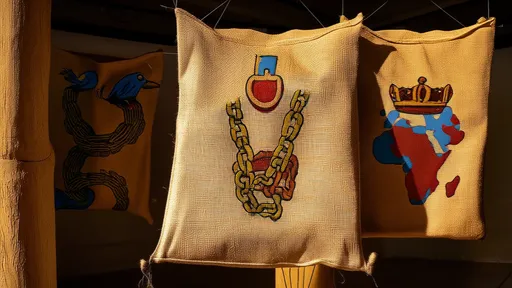
The jute sack, a humble and ubiquitous object in the global trade of commodities, has been transformed under the skilled hands of Ghanaian artists into a profound canvas of colonial memory. These coarse, brown bags, once used to transport cocoa, coffee, and other raw materials from the colonies to the metropoles of Europe, are now being reclaimed. They are no longer mere containers of goods but vessels of history, etched with the invisible ink of exploitation and the visible scars of inequality.
In the bustling art studios of Accra and Kumasi, a powerful narrative is being woven, quite literally, into the fabric of these sacks. Artists like Ibrahim Mahama have pioneered this movement, utilizing the jute sack as his primary medium. The sacks he uses are not new; they are sourced from markets, ports, and farms across Ghana. Each one carries its own story, marked by stamps, logos, numbers, and the general wear and tear of its arduous journey. These markings are the colonial traces—the insignias of European trading companies, the codes for destinations like Hamburg or Liverpool, the faded instructions in foreign languages. To the untrained eye, they are simply blemishes. To the artist and the informed viewer, they are hieroglyphs of a painful past.
The very materiality of the jute sack speaks volumes. Its rough texture is a tactile reminder of the harsh labor conditions under colonial rule. The fibers are stained with the sweat of countless unnamed farmers who toiled on plantations to feed the industrial appetites of distant nations. When these sacks are stitched together to form vast, imposing installations that drape over grand public buildings—such as Mahama’s celebrated covering of the façade of the prestigious Barbican Centre in London—the effect is jarring. The coarse, functional material of the Global South envelops the smooth, polished architecture of the Global North, creating a stark visual metaphor for the entangled and often oppressive relationship between the two.
This artistic practice forces a confrontation with the lingering architecture of global inequality. The colonial project was not merely about political domination; it was an economic system meticulously designed to extract wealth. Raw materials were taken from Africa at minimal cost, processed in European factories, and sold back to the colonies as finished goods at a significant profit. The jute sack is a perfect symbol of the first, extractive stage of this process. By elevating this symbol to the status of high art, Ghanaian artists are compelling a re-examination of the very foundations of our modern global economy. They ask us to consider who truly profited from the cocoa in our chocolate, the coffee in our cups, and the cotton in our clothes.
The dialogue initiated by these works extends beyond a simple condemnation of history. It is a nuanced exploration of contemporary realities. The independence of Ghana in 1957, and of many other African nations thereafter, did not magically erase the economic structures put in place by colonialism. Today, the trade in primary commodities continues to be characterized by significant price disparities and power imbalances. Multinational corporations often wield more influence than national governments. The jute sack, therefore, is not just a relic; it is a mirror reflecting ongoing patterns of dependency and unequal exchange. The artists are not nostalgists mourning a bygone era; they are sharp critics of the present.
Furthermore, the act of repurposing the sacks is itself a powerful statement of agency and resilience. It is an act of alchemy, turning an object associated with subjugation into a medium for powerful self-expression and critique. The meticulous process of collecting, cleaning, and stitching the sacks is a form of historical archaeology. It is a way of piecing together a fragmented history from the discarded remnants of the global market. In doing so, the artists are not just representing history; they are physically reworking it, asserting control over the narrative in a way that their ancestors could not.
The international art world’s embrace of this work adds another layer of complexity. When these installations are displayed in major galleries and museums in Europe and America, they initiate an uncomfortable conversation within the very spaces that have historically defined and confined "African art." The presence of the jute sack—a symbol of raw, unprocessed African labor—within the sanctified white cube of the contemporary art museum challenges the institution's own potential complicity in systems of cultural and economic valuation. It questions who gets to tell whose story and under what terms.
Ultimately, the art born from the jute sack is not meant to provide easy answers. It is meant to provoke a deep, lingering discomfort. It asks viewers to trace the invisible lines that connect their daily comforts to distant fields and forgotten laborers. It demands an acknowledgment that the prosperity of some has often been built upon the exploitation of others. The colonial traces on the sacks are not ancient history; they are the genetic code of our modern world, encoding patterns of wealth and poverty that persist to this day.
Through their profound and unsettling work, these Ghanaian artists have achieved something remarkable. They have taken a simple, functional object and imbued it with the weight of centuries. They have transformed the jute sack from a symbol of silent extraction into a loudspeaker broadcasting a crucial message about memory, responsibility, and the urgent need to reimagine a more equitable global future. The conversation is no longer confined to history books; it is draped over our buildings, hanging in our galleries, and impossible to ignore.
By /Sep 26, 2025

By /Sep 26, 2025

By /Sep 25, 2025

By /Sep 25, 2025
By /Sep 26, 2025

By /Sep 26, 2025
By /Sep 25, 2025

By /Sep 26, 2025
By /Sep 26, 2025

By /Sep 25, 2025

By /Sep 25, 2025
By /Sep 25, 2025

By /Sep 26, 2025

By /Sep 26, 2025
By /Sep 25, 2025

By /Sep 26, 2025
By /Sep 25, 2025

By /Sep 25, 2025

By /Sep 26, 2025

By /Sep 25, 2025
