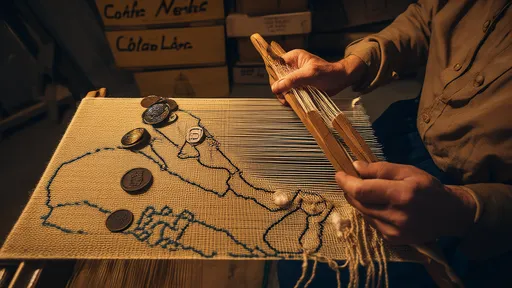
In a quiet studio filled with the earthy scent of raw fibers, an artist meticulously weaves a tapestry not just of thread, but of time and trade. The material in her hands, a coarse jute, once carried coffee beans across oceans; the cotton strands, now dyed with indigo, whisper of colonial plantations and the sweat of forgotten laborers. This is the quiet, potent work of contemporary artists who are turning to fibrous materials—jute, cotton, silk, wool—as archives of global exchange. They are not merely using these materials for their aesthetic qualities but are engaging with them as carriers of historical memory, using their tactile presence to explore the vast, often invisible, currents of global commodity flows.
The very nature of fiber makes it an ideal medium for this exploration. Unlike stone or metal, fibers are pliable, absorbent, and intimately connected to the body and to land. They are grown, harvested, processed, spun, and woven, each stage embedding a narrative of labor, geography, and economy. An artist working with raw cotton is handling the product of specific soil, climate, and human hands. A length of silk thread contains within it the history of the Silk Road, a network of trade that connected East and West for centuries. These materials are, in essence, solidified history, their journeys mapped onto their very structures. By re-contextualizing them within art, creators are performing an act of archaeological excavation, unearthing the stories trapped within the weave.
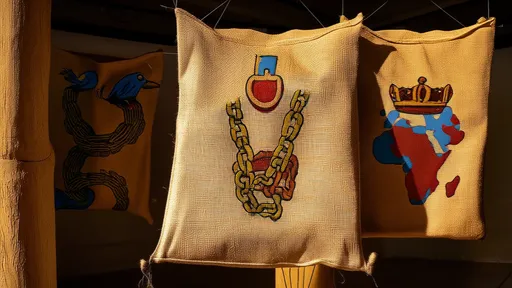
Consider the humble jute sack. For decades, it was the anonymous workhorse of global trade, transporting everything from grains and cocoa to coal and coffee. It was a ubiquitous object, seen but never truly looked at, its rough texture and printed logos fading into the background of commerce. Artists today are salvaging these discarded sacks, seeing in their stains, tears, and markings a profound record of movement. One artist might stitch together sacks from different continents, creating a large-scale map that visualizes trade routes. The stains on the fabric become topographical features—a coffee spill marks a port in Brazil, an oil smear indicates a shipping lane in the Middle East. The artwork becomes a palimpsest of commerce, where the physical evidence of the goods once contained within tells a more visceral story than any economic chart could.
This artistic practice is deeply intertwined with a critique of colonialism and its enduring legacy. The global flow of commodities has, for much of modern history, been a story of extraction. Cotton, for instance, is inextricably linked to the transatlantic slave trade and the exploitation of the American South. Artists of the African diaspora are particularly adept at using cotton to confront this painful past. They might incorporate raw, unprocessed cotton bolls into installations, their fluffy whiteness belying a history of brutality. By juxtaposing this material with contemporary images or texts, they create a powerful dialogue between past and present, forcing viewers to confront the uncomfortable foundations upon which modern wealth was built. The fiber becomes a witness and an accuser, its softness a stark contrast to the hardness of the history it represents.
Beyond historical critique, fiber art also illuminates the complex, often precarious, nature of contemporary supply chains. In an era of fast fashion and disposable goods, the origin of the clothes we wear is more obscured than ever. Artists respond by tracing these chains backwards. One project might involve following a single T-shirt from a retail store in Europe back to the cotton field in India, documenting each step—the farmers, the spinners, the dyers, the garment workers—and then translating this journey into a woven piece. The resulting artwork is a dense, complex narrative that makes the invisible visible. It reveals the human cost and the environmental impact embedded in a seemingly simple object, challenging the abstraction of global capitalism.
The methodology of these artists is as important as their materials. Many employ traditional craft techniques—weaving, embroidery, quilting—that are themselves forms of cultural heritage often marginalized by the fine art world. By elevating these "women's work" or "folk art" practices to the level of high-concept contemporary art, they perform a dual act of reclamation. They are not only reclaiming the narrative of the materials but also the value of the labor-intensive processes used to transform them. An intricately embroidered map on a burlap coffee sack, for example, invests time and care into an object designed for disposability. This act is a quiet but powerful resistance to the speed and waste of consumer culture.
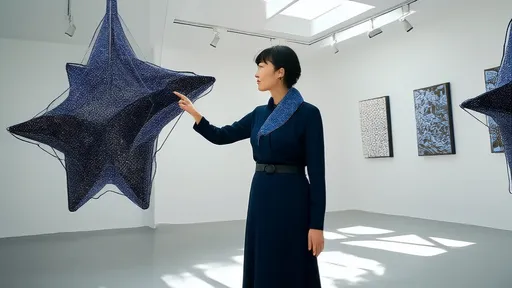
The finished artworks are rarely straightforward representations. They are layered, tactile, and demand a different kind of engagement from the viewer. One cannot simply glance at a sculpture made of knotted fishing nets and discarded clothing; one is compelled to consider its weight, its texture, the stories of migration and loss it might contain. This haptic quality is central to the art's power. It bypasses the intellectual and appeals directly to the senses, creating an empathetic connection. The viewer feels, almost physically, the journey of the material. This is the unique capacity of fiber: to make abstract economic forces tangibly human.
Ultimately, this movement in art is about re-enchantment. It is about looking at the material world around us—the clothes we wear, the sacks that carry our food, the carpets we walk on—and recognizing them as repositories of countless stories. These artists are cartographers of a different kind, mapping not geographical space, but the flows of capital, labor, and culture that shape our world. By giving form to these invisible networks, they offer a critical perspective on globalization. They remind us that every commodity has a biography, and that these biographies, woven together, form the complex and often contradictory tapestry of our shared human history. In their hands, a simple thread becomes a line connecting us to distant lands, past injustices, and future possibilities.
By /Sep 26, 2025
By /Sep 26, 2025

By /Sep 25, 2025

By /Sep 25, 2025
By /Sep 26, 2025

By /Sep 26, 2025
By /Sep 25, 2025

By /Sep 26, 2025
By /Sep 26, 2025
By /Sep 25, 2025
By /Sep 25, 2025
By /Sep 25, 2025
By /Sep 26, 2025
By /Sep 26, 2025
By /Sep 25, 2025
By /Sep 26, 2025
By /Sep 25, 2025

By /Sep 25, 2025
By /Sep 26, 2025
By /Sep 25, 2025
